You Can See Everything (2026) | review + analysis
I see every person who came out of this film with an opinion on Elizabeth Holmes either negative or positive, her crimes or innocence of such, Nathan Fielder and his style of documentary filmmaking or the ethics of portraying real life people in fictional media as the people who have been duped by this film and by the story it presents.
At the core of it, You Can See Everything has put on display how many people are almost entirely unwilling to accept that many things that may seem contradictory can be true all at once. So every single person who walked out of this film and confidently wrote up an article about how anyone offering sympathy to Elizabeth was duped, and everyone who wrote up reviews lambasting anyone who could ever dare to judge and laugh at this sad, raped woman – all are the marks who got worked, refusing to see the only objectively true thing Fielder and Oppenheim were able to show us.
It’s been about three days since I sat in the theater and watched You Can See Everything. On the way there, my wife asked me what I was hoping to get out of the film and my answer was ‘some kind of clarity on why this all happened’, and three days out from the credits rolling, I can safely say that I have achieved ‘some kind’ of clarity. To preface further diving into You Can See Everything, I want to disclose some things to the reader - I write a lot about problematic white women and their ability to leverage a particular kind of sympathy only white women are afforded in order to achieve their own (or some ideologies) goals. I am a film analyst and writer who is very, very aware of the biases one can have toward white women, both negative and positive. I am not in the business of infantilizing grown adult women, no matter how sad, or white or innocent they may be. As a viewer going into this film with an admitted and recognized guard up to the particular forms of manipulation that people like Elizabeth Holmes are capable of wielding, I did not expect to leave it with some warm sympathetic feelings toward the subject, but I did. The first (and only) thing I’ve posted in the aftermath of the film is a gif of Tanisha Thomas from The Bad Girls Club, where she reads something off a screen, says ‘wow’, shaking her head up and down, with a tear falling down her cheek, as she lifts her beautifully manicured hands up to her eyes to mask her anguish. I’m glad I don’t have a big account on film twitter because I fear this gif may have landed me in some hot water, being read as a nod to my conclusion of the film being sympathy for Elizabeth Holmes. I might not have had the time to really sit with that reaction, with my feelings, with all the things I saw and did not see, if that would have happened. I’m really glad it didn’t. Because I got to see more and more reviews and hot takes pour out in the days since I went and Saw Everything, and the more and more that I read, the less and less I felt anything at all about Elizabeth Holmes, Nathan Fielder, Billy, Seyfried, Oppenheim or any of the entities involved in the creation of the story that led us to this moment in time.
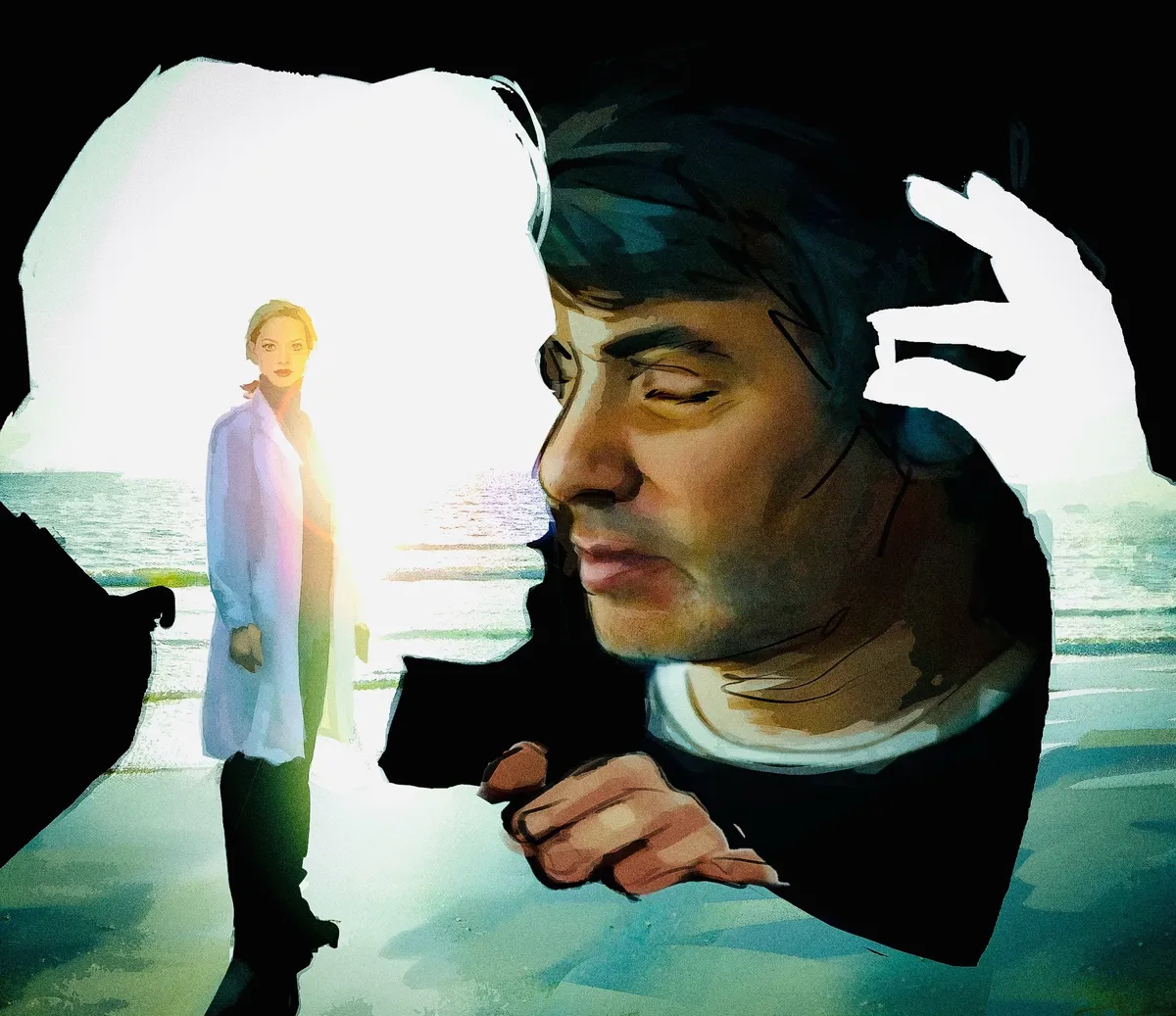
art by tumblr user grumfey
Every time I read a statement like “If you really believe Elizabeth Holmes is the victim in this situation you got duped”, I feel my insides curl up a little. There is seldom one victim in a situation as complex as this one, so no, Elizabeth is not the victim, but she is a victim. When I say this, I am not referencing her relationship with Sunny, nor with Billy, nor her parents or Nathan or even the unnamed person who raped Elizabeth when she was in college. When I reference Elizabeth as a victim, I am speaking of her as a victim of a system I do not believe anyone, innocent or guilty should become a victim to – the American Prison System.
I do not believe people should be put in cages. I do not believe there are things people can do that render them no longer human and undeserving of human rights. I accept that there are a lot of people I will lose here, people who will immediately bring up people who commit the worst crimes, rapists and serial killers and and and. Yeah, I get it. I don’t have all the answers for how to create a better world, I just know that I want one. I just know that I believe prison is fundamentally inhumane and I don’t want human beings there. I am seeing Elizabeth as a victim of this system as a human being, and this is why I felt so horribly leaving the theater, the last shot of the film leaving such a sour taste in my mouth. And for a while, I was convinced that I was feeling this empathy for Elizabeth and her situation, this sickness in my gut over it all because I was manipulated into it by a really wonderful piece of filmmaking. It took time. Hours and hours of deep thought, creating hypotheticals in my head to argue against my own feelings. But eventually, I came to understand why I felt so horribly, why I was moved to such emotion after watching a woman who I believe to be guilty, experience punishment that pales in comparison to the punishments people without all the privileges she holds receive.
I kept looking for who I could trust in this scenario, and why I could trust what they’re saying. Is Nathan being honest? Is Elizabeth? Is Billy? Is Amanda? But that’s all kayfabe anyway. A performance. I’m watching a movie. This is the first time I’ve ever been to the theater to see a documentary. This is a movie. I am reminded of how excited I was when Christopher Abbott appeared on screen (he is my favorite contemporary actor, absolutely obsessed with his body of work and skill set). I think of how important it is in polite society to perform normalcy to receive sympathy, and then I remember that we never actually get to hear most of the things that Elizabeth says after she is incarcerated. The closest we get is kayfabe segments, re-enactments of Amanda interacting with herself performing as Elizabeth. We don’t get to ‘see anything’ let alone see everything in the last half of the film. The only thing that allows us to ‘see everything’ is our own trust in what we are being shown. It’s about trust, not truth. I think of Elizabeth saying ‘how could you do this to another woman’ to Amanda, and then I think of the fact that I never actually heard Elizabeth say that, only Amanda acting as her. Amanda's performance, and her reaction. None of that belongs to Elizabeth, not really.
Nothing really does, not anymore. Because Elizabeth is an incarcerated woman. For the last half of the film there is nothing but surrogates of Elizabeth. For Billy, an AI likeness and for Nathan and Lance, Amanda. So, that’s where we arrive at my conclusion. It doesn’t matter if Elizabeth is telling the truth, or believes she is telling the truth – it only matters that powerful people believed that she was, until they did not, because now she is (something the film never refers to her as) a criminal and is acceptably removed from public life.
The scam of You Can See Everything isn't what Elizabeth Holmes did with Theranos or what Billy is doing with Theranos 2.0 and the various schemes he is involved with, nor is it Fielder and Oppenheim and A24 and the box office wins – it's the validation so many people are wholesale offering to the American Prison Industrial Complex. Elizabeth wins my empathy, not as a woman, not as a white woman, a victim of rape and misogynistic men who aim to utilize her like a puppet with no regard for her humanity, she wins my empathy as a human being who does not belong in a cage, she wins my sympathy through my disgust at the inhumane carceral system.
Fielder and Oppenheim did not do anything revolutionary by making me feel empathy for someone as they sit on the phone and are told that they will be subjected to random invasive full-body cavity searches, and quite frankly, Elizabeth could have been any human being in that moment and I would feel disgusted by what I am witnessing, because I find the entire institution to be inhumane and cruel. I am afraid of this loss of freedom, and that fear is a valid thing. It has little to do with Elizabeth Holmes, the woman, but everything to do with human beings, and the experience of being one.
In prison, Elizabeth cannot receive calls, she can only make them, two minutes at a time, first come first serve. All of these calls are recorded and monitored, of course. She makes 30 cents an hour, not enough to afford the turkey jerky she likes in the visitation room vending machines. She is incarcerated, and she is watching her children grow up one week at a time. I think she is a smart woman who understands the position she is in, and is seeking out the least painful method of exploitation that she can, since this position of exploitation is one I do not think she feels she will ever be able to exist outside of, a symptom of the cruel and icy response to her being raped in college (keep going, if you stop you only punish you, nobody can make it better anyways). Elizabeth Holmes is not an innocent woman, and this is cruel. She is guilty and it is cruel. I can hold those truths simultaneously without my world turning upside down, because expressing here that I hate the American Prison system and I do not believe in human beings, guilty or not, being caged is not going to free her, or any of the human beings subjected to incarceration as ‘rehabilitation’. It is true that Elizabeth Holmes was afforded time to get her affairs in order before voluntarily surrendering herself, that we never see her in a pair of handcuffs or restraints of any sort, that her family was solvent enough to move to Texas and buy a house near her facility so they could easily come to see her every week. All this is true and it’s also true that prison is a fucked up thing that we do to humans to punish..i mean..’rehabilitate’ them.
You Can See Everything proves that we’re all being scammed. We are shown 30, 40 minutes into the film (and at many points beyond this) that there is absolutely zero process of rehabilitation that has been committed to or encouraged by the looming threat and eventually fulfilled promise of incarceration. Elizabeth Holmes and her beau worked incessantly on Theranos 2.0 during many points in the film, and Elizabeth seemed her most authentic and happy when playing with her little devices or schmoozing on zoom with collaborators. This being done with similarly shady groups, similarly shady science, and a similarly controlling romantic partner who is also inseparable from the business. Elizabeth Holmes is not a reformed rehabilitated woman and no amount of time behind bars, away from her children is going to change that, nor will her presence there protect her from being puppeteered. Your articles on how everyone who feels sympathy for this woman is just a rube who lacks the ability to discern truth from fiction don’t make Elizabeth any more guilty than a court of law has already determined that she is, and put her behind bars for being. What it does, however, is reify and validate the structures actively locking hundreds of thousands of innocent (and guilty, idgaf, they shouldn't be in cages either) people in facilities far worse than Elizabeth was put in, and tell the people keeping those structures in place that we all, as objective observers and law-abiding citizens approve of human beings being caged for crime, especially if it really feels right. And I just don’t agree.
I don’t think Nathan Fielder and Lance Oppenheim set out to make a film about prison, but I think they did. And at the end of the day, I don’t think Elizabeth belongs in prison, and not because she said the right thing and Lance filmed it the right way and Nathan asked the right questions. It’s because she’s a human being. Something so simple was made so complex by the insistence on there being some kind of greater truth to it all. Elizabeth is guilty, and I don’t think she deserves to be in prison, because I don’t believe any human being deserves that. That’s really it. I don’t have much else to say. I am sad we live in this world and I don’t have better answers for it all. I just know I don’t like to see people celebrating incarceration, honestly. There’s this pervasive concept that we can make things fair this way, but I don’t think the scales will ever sincerely find balance like this. Put a human being in a cage to right a wrong. And around we go again.